
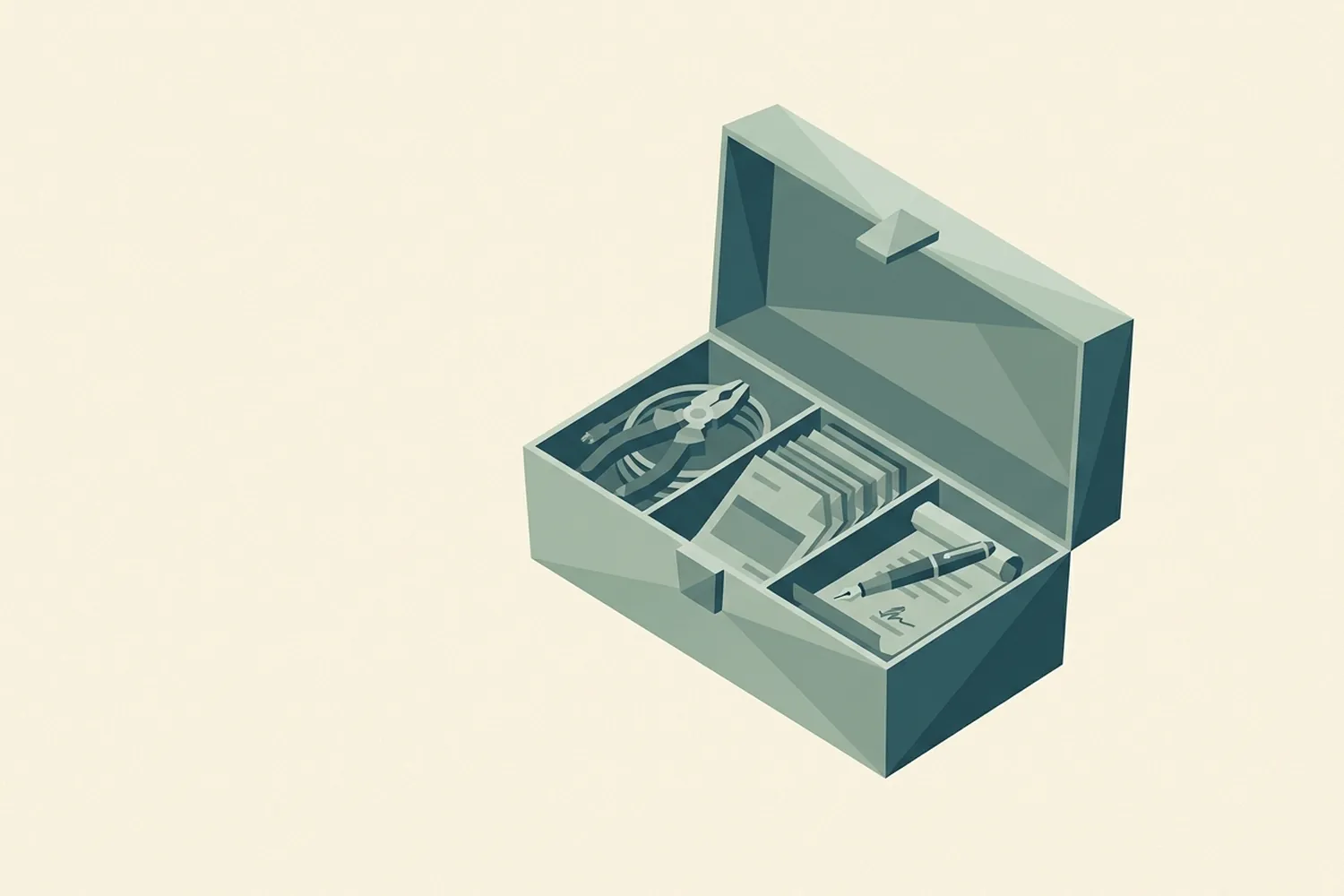
An electrician has to be good at being an electrician, of course. But a tradesman, in my view, should not see himself only as a labourer. He should see himself as a small company, one that has to be good at handling the administrative paperwork, at selling himself, the jobs, the labour, the projects and the services, and then also at the manual part.
With a friend who is an electrician I did a consultation: I looked at his financial statements and his processes, and after our meeting on 10 December 2025 I left him my notes, with the things to work on. Almost all of them are about prices, clients, quotes and numbers, that is, the paperwork and the selling. That is where I suggested he look for margin.
Why is a tradesman a company and not a labourer?
Because he does three jobs at once, and the client sees only one of them: the installation. At the end of June 2026 there were 1,226,925 registered artisan enterprises in Italy, just over one in five of all registered companies (Movimprese, Unioncamere and InfoCamere). They are companies in every respect, with a VAT number, suppliers to pay, clients to get paid by and sometimes employees.
The trade you can see is the work of the hands, the installation done well, to code and in the time promised. Behind it there is the paperwork, which the client never sees: quotes, invoices, deadlines, the trade association and the accountant to consult, the payments to chase. Then there are the F24 and the DURC, that is, the form for paying taxes and contributions and the certificate proving that contributions are in order. Selling comes before the work even starts, because someone has to sell himself, the job, the labour, a project or a service that continues over time.
Administrative obligations alone, that is, the part of the paperwork imposed by the rules, take on average 313 hours a year from an Italian micro or small enterprise. That is what CNA’s Osservatorio burocrazia says (6th edition, reported by CNA Reggio Emilia on 14 April 2025). It comes to 39 eight-hour days, nearly two months of work taken away from the hands and from selling.
Those who see themselves as labourers look after the trade they are already good at and put up with the other two. It is the same mistake I described when writing about strengths and blind spots: you keep training the thing that comes easiest and the rest falls behind. Seeing yourself as a company means giving the paperwork and the selling real hours too, just as you do with your job sites.
Where does an electrician’s margin hide?
What I wrote for him, minus what concerns only his business, holds for any manual trade.
In small jobs
On small amounts I wrote to him to set prices without the percentage markup. An invented example, to make it clear: replacing a socket takes a few euros of material and a call-out, between travel and work. Any percentage applied to a few euros of material stays at a few euros. That way the bill does not show what is really worth something, that is, the call-out, the time, the person who shows up and fixes it. On small jobs a fixed price for the job makes more sense, decided and told to the client before setting out.
In the fair price, before the discount
The first of my notes is about discounts, and there are two of them. One is the same for everyone and is written on paper, the other is personal, said in person to the client in front of you (“I’m doing this for you because…”) to make them feel special. Put like that, it can sound like the old trick of the inflated list price that then gets cut. It is not a trick. You start from the fair price, and the discount is a piece of margin you genuinely give up, to close the job. The personal one only makes sense if the because is true. Those who inflate the list price to make the discount look big get found out sooner or later, and lose both the client and face.
In the relationship with those who come back
Then there is the note on loyal clients, which sounds even worse when read in a hurry: every now and then a gift or a discount, but after raising prices. The way I read it, there are two different things inside it, and neither is a trick. First of all, the fair price. If costs go up and the price list stays still, you work for a little less every year, so prices get brought up to date, for clients who have been coming back for years too, and you tell them openly. And then there is the relationship with those who come back. Every now and then you give them a gift (for example an extra check, or a small thing fixed without putting it on the bill), as a thank-you and not to help them swallow the increase. The margin comes from the updated price, not from the gift. And the order matters, because a gift given on a price that does not cover the costs comes out of the tradesman’s own pocket. Right after it, the notes have a one-line point: never overdo it, because it takes a moment to lose face.
In the lean times
For the lean times I wrote to him to build a list of clients with other possible jobs. The list has to be written down, with the possible job next to each name (for example the old fuse board, the garage line, the solar panels put off). You open it in the weeks when the phone does not ring. In bigger companies they call it a sales pipeline.
In big jobs at low margin
They look like a mistake, and sometimes they are. But I wrote to him that it is fine to take on important jobs at low margin, if they give you the time to sell something else. A large site keeps the crew busy and leaves the owner the hours for finding and selling the next job.
How do you write an electrician’s quote that sells?
I also wrote to him to keep going with the new quote template, which was already under construction, focusing it on the benefits for the client more than on the technical aspects and attaching the technical specification separately. A quote made only of metres of cable, cross-sections and lighting points asks the client to compare technical lines. Those who cannot read them compare the only line they understand, the total.
Let me try an invented example, the wiring of a house being renovated, where the first page is for the client and answers their questions.
| The client’s question | What the first page answers |
|---|---|
| What changes in the house? | Sockets and lighting points where they are needed, the light that switches on from where you come in |
| What stops worrying me? | The old wiring, the power that trips |
| When? | The day work starts, the day it ends, how many days the house stays without power |
| How much? | The total, with what is included and what is not |
| And if something goes wrong afterwards? | Who to call, and how quickly they arrive |
The technical specification, with materials, metres and cross-sections, comes after, for whoever wants to read it. Only the order changes. The comparison with the other quotes no longer stays on price alone.
Where does a tradesman who wants to earn more start?
With one thing per trade, not all of them at once. On the hands there is little to say, you have to keep being good at it, because it is the condition for working, and the specialisation I talk about further down starts here. On the paperwork, the first step is to know every month, and not when the financial statements arrive, whether you are making money and on what. You need a control of the accounts that does not always depend only on the trade association or the accountant. The back office, that is, quotes, control of the accounts and replies to clients, can now be automated with AI, and I will write about it separately. An example of my own: in my company the monthly expense report starts from receipts photographed with the phone, which an AI model reads and classifies. It is one of the cases on the page about how I use AI. On selling, the smallest step is to rewrite one quote, just one, for benefits, send it that way to the next client and watch what happens.
The last of my notes for him was to keep searching for what sets his business apart from its competitors. In my view, in a manual trade money is made in two ways, as a rule. Either you increase volumes with low margins, or you reduce volumes with ever-growing margins, specialising in a high-value niche. It is a choice that deserves a piece of its own.
I had been doing cash flow, valuations and financial statements for a lifetime, but I had picked up the theory underneath in pieces, until I enrolled in Economics at 41. A tradesman usually starts from the hands, and the road he is missing is a different one: learning to read his own numbers over time. They help you understand where to increase margin, where to save on taxes and where to work better. He already does the paperwork and the selling every day, and when he starts treating them as work he realises he has a company, not just a van. If you have a small business and one of the three trades weighs on you more than the others, write to me.
These are an entrepreneur’s suggestions, not tax advice: on taxes and obligations the last word stays with your accountant.
Sources: Movimprese, Unioncamere and InfoCamere, press release of 23 July 2026 (1,226,925 artisan enterprises out of 5,823,863 registered companies at the end of June 2026); CNA, Osservatorio burocrazia, 6th edition, reported by CNA Reggio Emilia on 14 April 2025 (on average 313 hours a year of obligations for Italian micro and small enterprises, “nearly two working months”). The consultation notes are mine, from 10 December 2025; the business stays unnamed and without figures.