
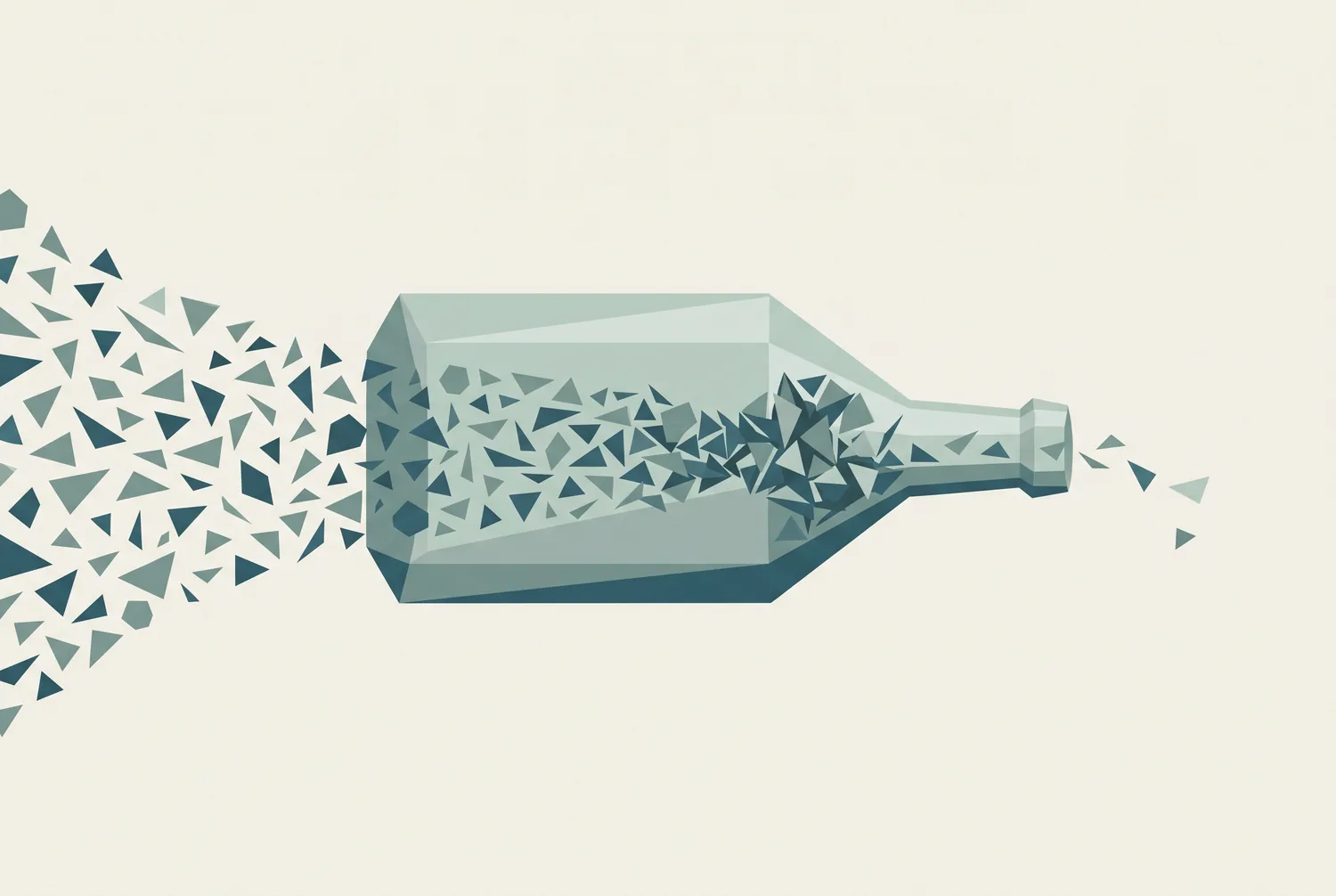
Everyone talks about how productive AI has made them. What it showed me is something less comfortable: the bottleneck, now, is me.
For twenty-five years the bottleneck in my productivity had one constant feature: it wasn’t me. Resources were missing, people were missing (people above all), there were development lead times, suppliers, sales networks to build from scratch. The frustration was constant, but it had a precise address, and that address was always outside my door.
Then AI arrived, and with it a discovery I wasn’t expecting: today I can do 90% of things on my own. No more waiting, no more dependencies. And for the first time in twenty-five years the brake is me: my brain, my cognitive capacity, my multitasking.
I can assure you it’s a completely different quality of frustration. When the bottleneck is you, you can’t fire it.
What happens when AI is faster than the person directing it?
What happens is that the limit shifts from production to supervision. Let me tell you about it through a real day.
A few days ago I was working on five projects at once, five terminals open: an AI routine to train my English, my digital twin (an entrepreneurial alter ego I’m training on a five-year horizon), my personal site, a content-creation workflow, and a decision roadmap to feed the twin. Five fronts, and on every one of them the AI was producing faster than I could think.
The result: from nine in the morning to four in the afternoon at high concentration on five fronts, then a fried brain. A kind of tiredness I had never felt in twenty-five years of work, because it wasn’t the tiredness of doing. It was the tiredness of keeping up with something I had set in motion myself.
The productivity paradox with AI
The more productive capacity AI frees up for you, the more ideas you have, and the more obvious your own cognitive limit becomes.
When projects depended on capital and people, I filtered new ideas upstream: there was no way to do them anyway. Now ten or fifteen come to mind, all of them useful for my private and professional life. And I can’t afford them. Not because of money, not because of people, but because I can’t hold them in my head. It’s the first time in my working life that the constraint isn’t capital and isn’t other people.
And here I have to say something that jars with the current grand narrative. Everyone tells you AI made them ten times more productive. What it did for me was show me my limit. A well-orchestrated AI, supervised proactively, could in theory run dozens or hundreds of projects in parallel: the limit becomes the token spend and the supervisory capacity of whoever is steering it. Which is to say, me. And five projects, nothing at all compared to what the tool would take, had fried my brain by four in the afternoon.
Is the human bottleneck a problem or a safeguard?
There is a serious school of thought that says this is how it should be. Human judgement has to stay the bottleneck, because that’s where the calibration lives, the experience, the senior who catches the mistake before it turns into damage. I made that argument myself, barely a week ago, writing about juniors and seniors: judgement is the moat. And on one point it holds: production can be delegated, judgement can’t.
But as an answer to the problem it isn’t enough for me, and I’ll say so plainly. Accepting your own brain as the permanent ceiling on your productivity looks a little too much like an elegant surrender. “It’s fine as it is” is what people say when they don’t feel like tackling the problem. I want to solve it.
Can you stop being the bottleneck of your own AI?
I don’t have the full answer yet, and I’d be wary of anyone selling you one. I have three directions I’m working on.
The first: separate production from judgement. Production parallelises, and that’s the AI’s job; judgement serialises, and that’s mine, one front at a time. Treating them the same way was the mistake I made that day.
The second: cut the cost of context switches. Every switch between projects starts from zero unless it finds a written state, a brief, an external memory ready and waiting. The brain shouldn’t be holding five projects in RAM. It should find them already laid out when it comes back to them.
The third: an orchestration layer, something that holds the open fronts together and brings me only the decisions, not the noise. That’s the project I’m working on right now, and honestly I don’t yet know where it lands.
What I do know is that this is becoming the entrepreneurial skill of the decade: everyone will use AI; orchestrating it beyond your own cognitive limit, without losing control of quality, almost nobody.
For twenty-five years I blamed other people for the slowdowns, and I was nearly always right. Now that the brake is me I’ve lost the alibi, and it’s the best thing that could have happened: for the first time the bottleneck in my productivity is something I can work on directly, every day. I don’t know how far it can be pushed. I know it’s the most interesting problem on my desk. And I suspect I’m not the only one: if you’ve also discovered you’re the brake on your own AI, I’d like to hear how you’re getting out of it.