
Yesterday OpenAI launched GPT-6 Astra and is pitching it as the world’s best computer use model: it navigates the browser, fills in forms, works through spreadsheets, moves across desktop applications and carries a job from start to finish the way a person sitting at the keyboard would. Technically it is impressive. Then I watch the use-case video and, among other things, I see it take a handful of template slides and build an entire deck on top of them, keeping tone and layout consistent to the last page.
What a letdown. Not because it is a small thing, it is an enormous one, but because I had the feeling of watching 2026 technology used to perfect a ritual from 1996.
Three years inside a corporate, watching meetings decide nothing
I am not speaking from theory. I spent three years inside a large organisation and watched hundreds of meetings built entirely around a PowerPoint, out of which came no decision at all. None. You left with a round of emails, an updated file and the next meeting in the calendar.
What left me speechless was the cost of production, and I am not talking about four or five people. I am talking about dozens, because before the real meeting came the reviews. The pre-review with your direct manager, the one with the other function that had to sign off, the round of comments by email, the updated version, another pre-review because a number had changed in the meantime, and round it went again. Every pass moved different people: someone pulling data out of a system, someone pasting it into Excel, someone laying it out, someone enriching it because as it stood it looked thin, someone rereading it to find the wording that offended nobody. Dozens upon dozens of hours of good, well-paid people, added up on a file. And then the meeting consisted of reading that file out loud, slide after slide, to people who had already received it.
Over time I understood that the effort was not a side effect: it was the function. The deck had become an instrument for avoiding responsibility. It stretched timelines, because nothing gets decided until the document is ready. It spread responsibility across three layers of hierarchy, so that in the end it belonged to nobody. And above all it worked as an emergency exit: when something went wrong, there was always the option of saying it was written on page fourteen and somebody had not read it properly. Hard to find an insurance policy that costs so little and covers so much.
A PowerPoint should only be visual support, a way of helping the listener follow what you are saying. And a meeting should have a stated subject, a purpose, and an outcome you intend to carry out of that room. Take those three things away and what remains is a ritual that consumes the time of ten people. Which is exactly why the people who want to work, inside companies, hate meetings: not because they are antisocial, but because they have learned to recognise when they are watching a performance.
The first one to get it wrong, though, was me
Before I take it out on OpenAI I should get in line, because I made the same mistake myself. At MenthorQ, the American SaaS where I am CFO, I automated the monthly board pack: from raw data to P&L, unit economics and KPIs with the narrative already written, in hours instead of days. I am still proud of it, so much so that it is one of the cards on the page where I describe what I build with AI.
A few months on, though, the honest reading is different: I automated the production of the document, not the decision. The board reads faster, discusses the same way it did before and decides with exactly the same latency as before. I took days of work off my own plate, which is not nothing. I did not take a single hour off the gap between the moment evidence exists and the moment somebody owns a choice, which is the only thing that actually moves the numbers.
Optimising the wrong bottleneck is a mistake I spot instantly in other people and took me a whole summer to see on myself. It is also a theme I have already tripped over in a different way, so let’s say I have some experience.
The thirty-year-old aftertaste
Then there is something I say with affection, because I built part of my own career on PowerPoint: it tastes of thirty years ago. The 16:9 rectangle, the title on top, the aligned bullets, the transition, the laser pointer. It is a format born when data lived on an overhead transparency and a projector was an achievement, and it is still the standard object a multinational uses to decide where to put twenty million. That this is still true in 2026 is, at the very least, curious.
My own method, for a while now, has been to replace it with HTML. And it genuinely works better: a page hooks into real data, changes while you look at it, lets you go down into detail, integrates graphics and sound decently instead of with clip art, shows three scenarios instead of one. Above all, AI writes it in minutes today, which I do regularly. Anyone moving from a deck to an HTML artefact makes an immediate step up, no argument.
But here I have to be honest with myself, and it is the point of the whole piece: moving to HTML changed the visual medium, not the paradigm. The process stayed identical, namely somebody prepares an object and shows it to everybody else, and everybody else watches. I made the performance prettier and richer. I did not change the fact that it was a performance.
The Decision Room
The real leap isn’t a prettier document. It is an environment where data, reasoning, options, decisions and execution all live inside the same object. I would call it a Decision Room: a living artefact, connected to official sources, queryable during the meeting and able to turn a decision into execution without leaving the context. The underlying difference is that today we build a narrative and then try to decide, whereas there we would build the context needed to decide directly.
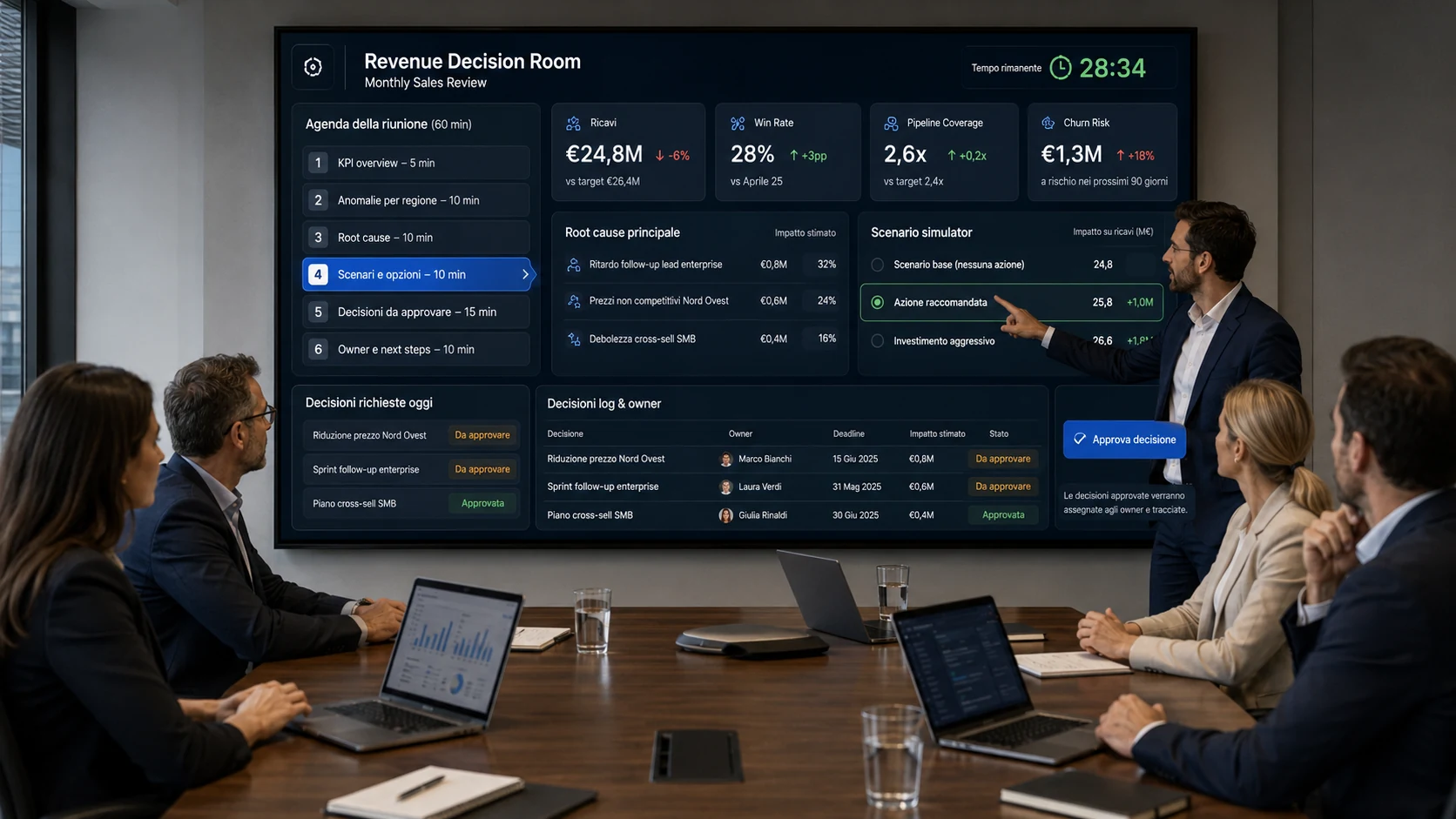
I had Astra itself generate that mockup, to see whether the idea held up visually, and it does. There is a certain irony in having the alternative to the deck drawn by the very model that disappointed me by making a deck. Six things live inside it. The agenda as the contract of the meeting, with the sequence of topics, the time allocated and the decision expected from each block, which is exactly the subject and purpose that the meetings I sat through never had. KPIs read live from the official systems, with timestamps and the ability to go down into the data, not screenshots taken the Friday before. An AI briefing on anomalies, weak signals and causal hypotheses, with the confidence level stated and the evidence always one click away. A scenario simulator that prices the alternatives while you are discussing them. A log of decisions approved in the same environment, with rationale, owner, deadline and verification KPI. And execution, which starts from there and updates itself for next month’s meeting.
Look at the timer in the top right and the block of decisions awaiting approval: those are the two details that change the physics of the room. You know how much time is left and you know what you have to carry out before you leave. Picture the same meeting without those two elements and you have described every meeting you attended this year.
Take the monthly sales review, which exists practically everywhere. Today it takes days of preparation and dozens of slides. In this format the storyline doesn’t disappear, it becomes more explicit: five minutes on the KPIs to see what is happening, ten on the anomalies to see where the problem sits, ten on causes, ten on scenarios, fifteen on the decisions to approve and ten on who does what by when. During the meeting you don’t page through slides, you walk a decision sequence, and when a choice is approved the owner and the KPI are already attached to it.
At that point PowerPoint is no longer where the work is born. It becomes an export format for external communication, archiving and compliance, which is to say for every situation where a still photograph is genuinely what you need.
But how do you get thirty thousand people to adopt it?
This is the question that usually kills beautiful ideas, so I ask it of myself first. You cannot ask thousands of people to become designers, developers or prompt engineers: the new paradigm has to be simpler than PowerPoint, not more complex. So you don’t hand out an empty tool, you hand out vertical products already configured around the rituals the company repeats every month anyway, from the executive committee to financial control, from the sales pipeline to the operations control tower and the investment committee.
Under the hood you need the boring part, which is always the part that decides whether something works: templates per meeting type, connectors to the official sources, permissions, audit trail, versioning, and one non-negotiable rule on decisions that matter, namely that the AI prepares and people decide. It is the same principle I run my portfolio on, where the AI prepares the order and the hand that sends it stays mine. That isn’t an efficiency limit, it is the point where control becomes real instead of declared.
The metric changes too. Not how many slides we produce, nor how many hours AI saves us on formatting, but how many quality decisions the organisation manages to make and execute per unit of time. A company can have more data, more dashboards and more AI than its competitors and still be desperately slow. The advantage appears when it converts information into choice, choice into ownership and ownership into results faster than anyone else.
One honest disclaimer
The Decision Room is a proposal of mine, not a product that exists and not something OpenAI announced. Astra and the new generation of agentic models make it plausible, because the technology can already move between applications, read context, produce artefacts and follow multi-step workflows. But between plausible and working sit the connectors, the permissions and above all the habits of a few million people, and that is the part no model solves for us.
If we use AI to do better what we did yesterday, we get incremental productivity, which is still a good deal. If we use it to question the deliverable itself, we change how organisations work.
The math I hadn’t done
What I take away from all this isn’t about OpenAI. It is that for three years I watched good people burn weeks on files that made nobody decide anything, I assumed the problem was the quality of the files, and when I finally had the tool to fix it I automated the production of the files. It is the same mistake we make when we buy a new tool for a workflow that should be deleted, and it has the hidden advantage of always feeling productive.
The question I’m left with is simple, and it reaches well beyond AI: if we could redesign a corporate meeting from scratch today, would we really invent a forty-page file to project onto a wall? I don’t think we would. And what makes me optimistic is that, for the first time since I started doing this job, the answer no longer depends on who has the software budget, but on who has the curiosity to question their own Friday afternoon.
Sources: OpenAI, GPT-6 Astra, 3 September 2026; Fortune and CNBC on the launch and the computer use capabilities; Engadget on the launch video, which also shows slideshow building; the demo of a deck built from a handful of corporate-template slides is on the OpenAI launch page cited above. The Decision Room mockup is an image generated with GPT-6 Astra for illustrative purposes. The observations on PowerPoint, decision processes and Decision Rooms are an editorial proposal, not a description of an existing product.