I was frustrated.
I use AI heavily in every part of my work. I have automated and improved whole company departments, back office, accounting, marketing, sales and much more. I have built custom software, dashboards of every kind, complex agentic layers, work pipelines, routines, you name it, and I was still frustrated.
Too many terminal windows open, or too many Claude Desktop sessions open at the same time, too many projects open at the same time, and yet I did not want to give anything up. I wanted to do more and more, more and more in parallel, faster and faster, and raise the quality as well.
The result was that I was failing, because I lost the thread, I saturated my cognitive capacity fast, I decided worse and in a muddled way, and after 6-7 hours my brain was completely fried and the headaches and the frustration set in.
I had to find a solution.
I knew the problem very well, and it all comes down to 2 simple words: Customer Experience, that is UX and UI.
LLMs and AI agents are infinitely powerful, an incredible technology. But they need to be supported by a UI and a UX that live up to them, that is by a customer experience of the same level. It is what lets human beings, too, express themselves at their best while working with them. It was hard, but I made it. I got there in three steps, from the terminal to the Claude Code desktop app and on to RONI’s desk, where I have been working since 7 October 2026. RONI comes from an open source project by Giuseppe of Running Dolphins. Here I describe how it is built, explained without code, and what changed in my days in the three weeks before and the three after. The piece is long but worth it. Ready for the ride?
1. The fatigue was not the AI’s
With the terminal I could handle two or three projects, with the desktop app four or five. Both times, the first to give way was me.
Until August I worked with Claude Code in the terminal, the black window where you only write and read text. I kept two projects open at the same time, three at most, and after six or seven hours my brain was fried, because black screens are exhausting. The day I opened five I was cooked by four in the afternoon. At the end of June I wrote a piece about it: I have become the bottleneck of my own AI.
In August I moved to the Claude Code desktop app, and things went better. With a very large screen I could keep four or five sessions open. But then I would lose track of where I had got to. And in the evening I had a headache anyway.
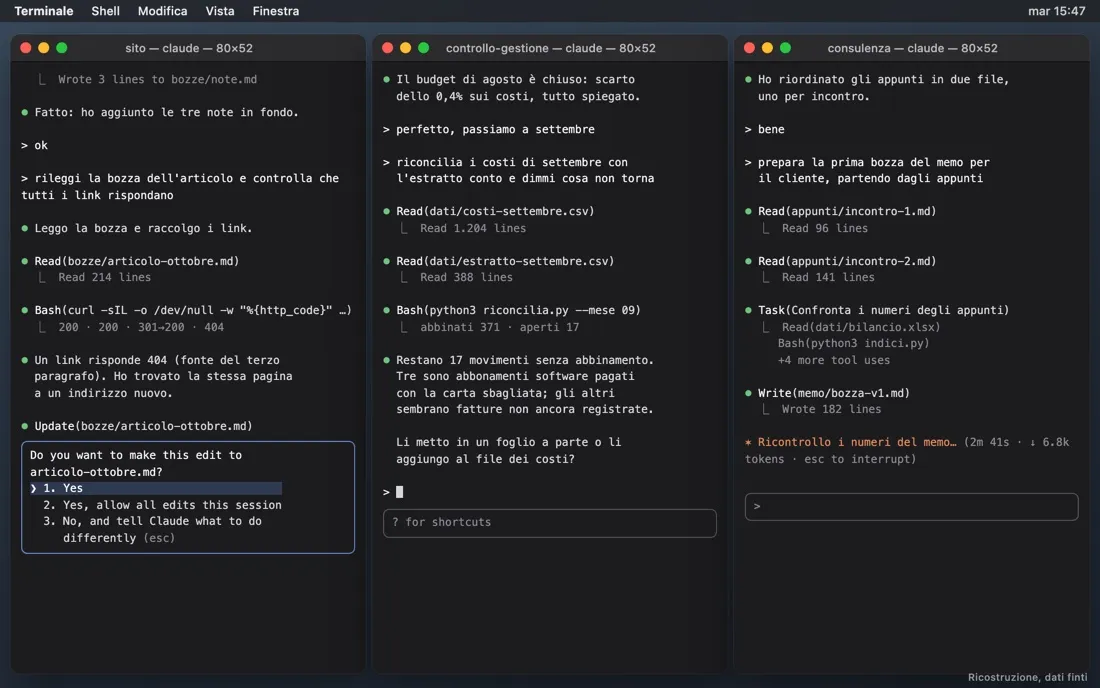
The “before”, reconstructed with fake data. Three terminals in parallel were already my maximum.
The problem, in both cases, was not how much the AI produced. It was being able to interact with it more naturally, above all with agentic AI, the kind that works on its own on a task, while keeping control of all the open projects without saturating my cognitive capacity as a human being.
2. The starting point is Giuseppe’s
I did not invent RONI’s desk. It arrived on my Mac already working on 7 October. Then I built on top of it for three weeks, with the agents.
Giarbis is an interface for Claude Code, a page in the browser where an assistant works with you. When a job is long, it hands it to other agents working in parallel, all visible on a map. It is a project by Giuseppe, of Running Dolphins, and his repo is public on GitHub under the MIT licence, with installation instructions.
It reached my Mac in a single commit of 119 files and 12,188 lines. Inside were already the server, the sessions, the map, the chat, the voice and the sheets, where the assistant shows charts and tables over the map.
From 8 to 28 October the commits from my account added about 34,000 net lines of code (38,170 added, tests included). The agents wrote them, while I chose and tested. That is how the two views of the map were born, Quadrante and Costellazioni (the clock dial and the constellations), and the Cupertino and Polpo skins. Then the Today page, the pending decisions, the routines, iMessage, the Gallery, the nightly review we call the dream and, since 17 October, the 3D face. On 28 October the expressions of chapter 4 joined it.
The name changed on 28 October. Born Giarbis, the assistant is called RONI today, Return On Nick’s Intelligence 😉. A name like that can only be defended by treating it as a promise to be measured, and if the return is there it must show in the numbers of chapter 9.

On 17 October I added the 3D version, and you can tell RONI’s state before you read anything.
3. How it is built, without code
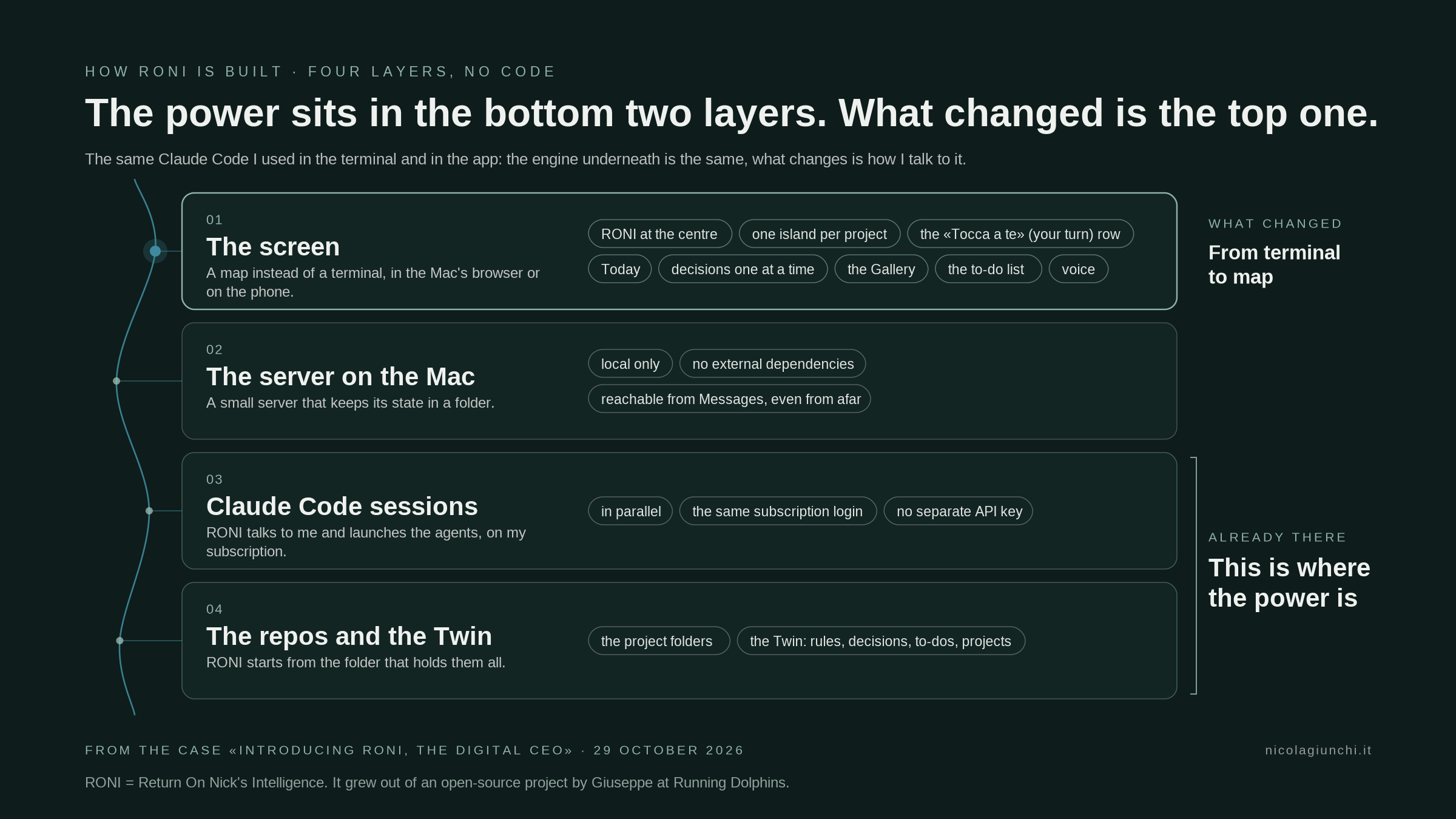
Four layers, from the screen to the folders. The power is in the bottom two, which were there before too; what changed is the first. Everything, from the Mac to the iPhone to iMessage, runs in the Apple ecosystem.
The first layer is the screen, and it is a map instead of a terminal. It opens in the browser on the Mac or on the iPhone, with RONI at the centre, one island per project, the agents as moons and at the top the “Tocca a te” row (your turn). Next to the map there is Today, with what went wrong and what is coming in the next 24 hours. Then the decisions one at a time, the Gallery with every page produced for me, the to-do list and the voice, because you can also talk to RONI.
The second is a small server that runs on the Mac, only locally and with no external dependencies, and keeps its state in a folder. From outside you reach it through iMessage, on the iPhone, and so RONI and I talk even when I am away.
The third is the Claude Code sessions, on my subscription. RONI talks with me and launches the agents, and each of them works in parallel with the same login, with no separate API key. It is the same Claude Code I used in the terminal and in the app. The engine is the same, what changes is how I talk to it.
The fourth is all the repos, that is the project folders, plus the Twin, the system where I keep rules, decisions, to-dos and projects. RONI starts from the folder that contains them all, which is why it sits one level above all the repositories and can start a job on any project, and its modules read from and write to the Twin.
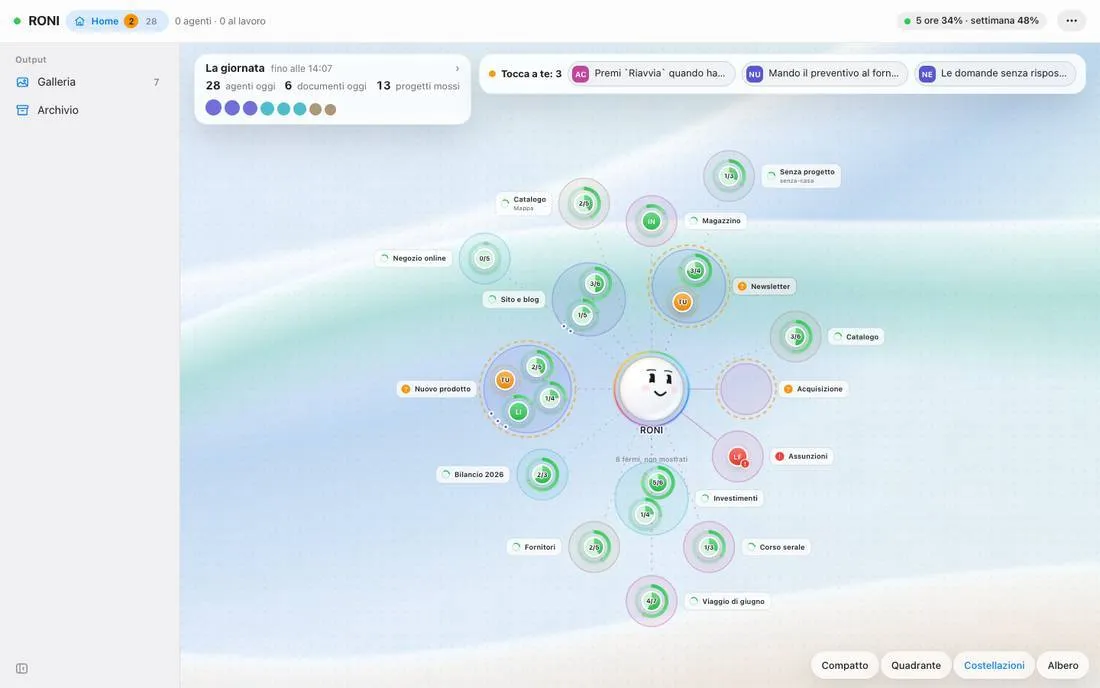
Costellazioni (test data), with RONI at the centre, one island per project, the agents as moons and at the top what is waiting for me.
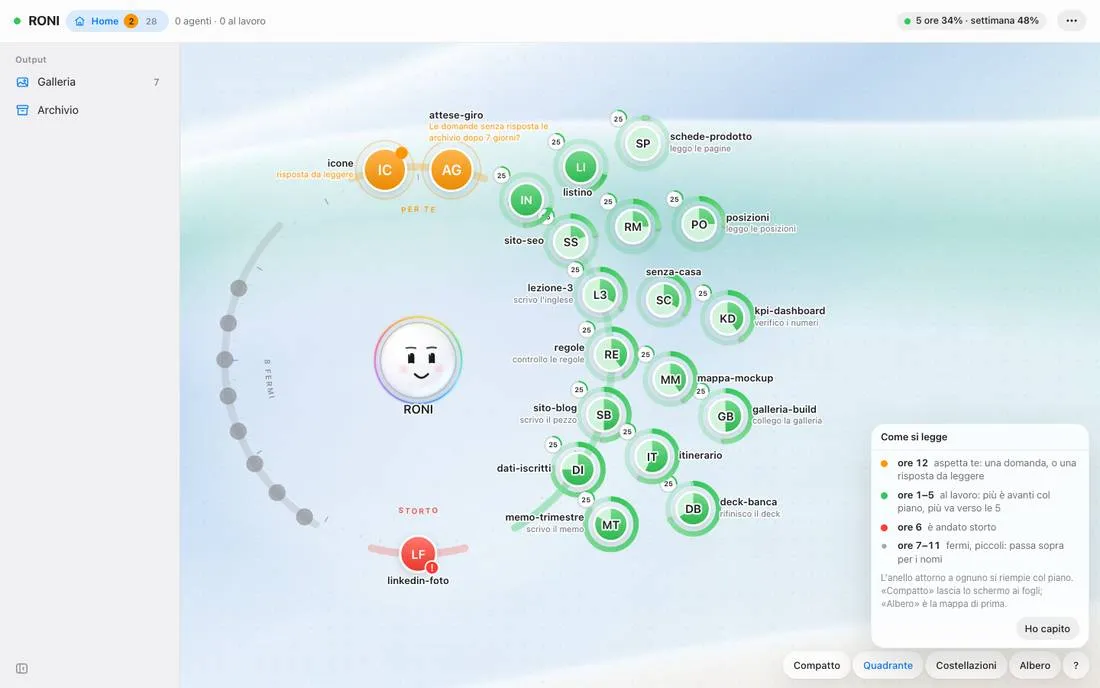
The Quadrante reads like a clock. At twelve o’clock whoever is waiting for me, on the right whoever is working, at the bottom whoever went wrong.
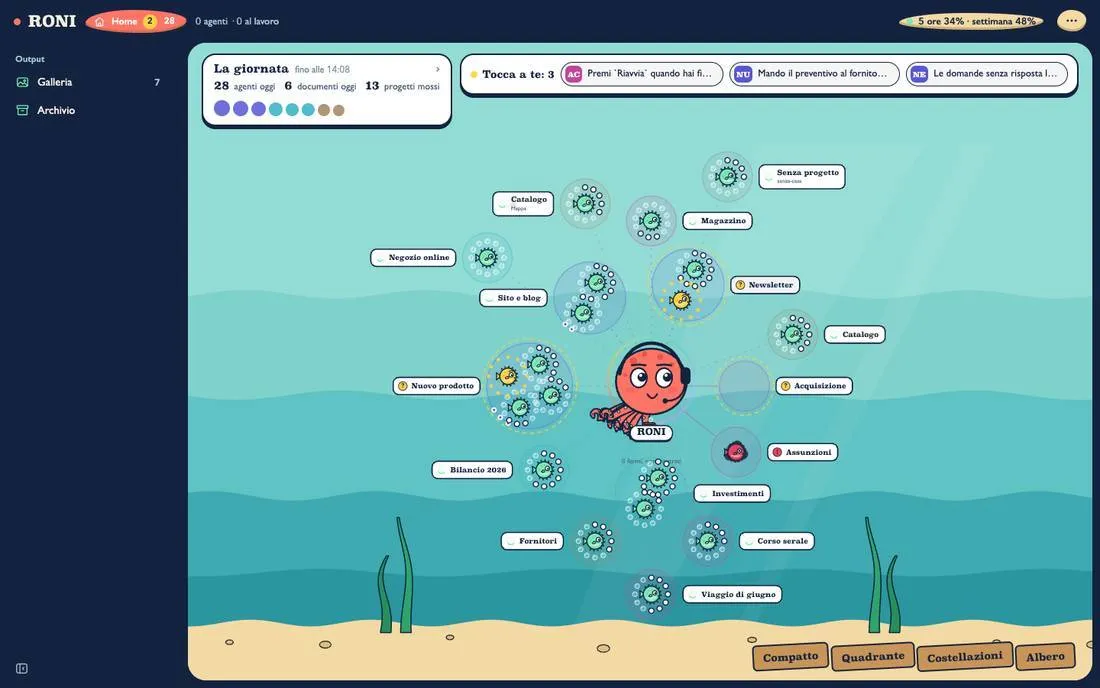
The everyday skin is Cupertino, clean and light. In Polpo (Italian for octopus) the same map goes underwater, the agents become little fish and RONI wears a switchboard operator’s headset.
The features, one by one
For anyone who runs a business and does not write code, here are the pieces of the desk one by one, with what they do and why I use them. I found about a third of them already built by Giuseppe (map, chat, voice, sheets, face, swarm, to-do list), the rest we have added since 8 October. The numbers come in the chapters that follow.
Seeing everything without remembering everything
- Costellazioni. It is the everyday map, with RONI at the centre, one island per project and the agents as moons. With the desktop app, at four or five sessions, I lost the thread; here I find it again at a glance, like a site manager looking at the building site from above instead of walking it room by room.
- Quadrante. The same agents, arranged like the hours on a clock. At twelve o’clock whoever is waiting for me, on the right whoever is working, at the bottom whoever got stuck, on the left whoever is idle.
- “Tocca a te” (your turn). A row at the top, with a number. If it is zero, I can get up from my chair.
- Cupertino and Polpo. Cupertino is the serious skin, light and clean. Polpo takes everything underwater, the agents become little fish, RONI an octopus with a switchboard headset.
- On the iPhone. The same map, in my pocket. I decide even in a waiting room.
Deciding, one thing at a time
- Pending decisions. It was the thing I wanted most, to have only what matters on screen and one question at a time. Each one arrives with RONI’s recommendation, the recommended option already highlighted and a counter (“1 di 2”, one of two), and I answer with a tap or two words. It is the file a good general manager brings to a meeting, recommendation included. I decide, but I no longer rebuild the context on my own.
- Today. What went wrong, what is coming in the next 24 hours, what is my turn (with a single button, “Fatto”, done). The morning meeting, without the meeting.
Delegating and letting them work
- Agents and swarm. One agent for each delivery. When the job is long it splits into sub-agents, each with its task written out (one checks the numbers, one reads the contracts, one looks for suppliers). A team, except it never takes a coffee break.
- Routines. Recurring jobs that run on their own, at night too. If one breaks, its page tells me what happened and what to do (sometimes “Apri Chrome, poi Riprova adesso”, open Chrome, then retry now, is enough). The procedures that in a company sleep in a binder run here without anyone having to remember them.
- Sheets. Charts and tables that RONI opens over the map while we talk about them.
Checking without playing the inspector
- The rubric. Every delivery arrives with the list of criteria to meet, and a ✓ or a ✗ next to each one. Finishing a job does not mean doing it well, and this way I know where to look. The flaw is that the rubric is filled in by the agent itself (a bit like sitting the exam and marking it too).
- The refuter. Since 14 October an agent plays devil’s advocate on the numbers before they reach me. An in-house board of auditors, and one that never sleeps.
- The incident log. Every system error ends up here, written by me or by the agents. Before, nobody counted errors, and what is not counted gets repeated.
- The dream. At 23:50 the system goes over the day, the mistakes and the times I corrected it, and writes down the lessons to keep. It learns on its own, and I stop playing trainer every evening.
Remembering and finding
- The Twin. The memory under everything, with rules, decisions, pending items, incidents, to-dos, projects. It also holds the list of what stays mine (money, public exposure, people and deals, legal and tax, opening and closing projects). The company manual and the written delegation, in the same drawer.
- The Gallery. Every page RONI produces for me, in HTML, split by project and by day. I had already replaced slides with HTML, now it applies to everything, and I no longer hunt for deliverables in ten folders.
- The to-do list. These are not decisions, they are the things I have to do to unblock an agent. It stops in front of something it cannot do (or must not do, because it is up to me) and passes it to me; I do it, press “Fatto” and it starts again. It is the colleague who leaves the contract on your desk. There is nothing to decide, only something to sign.
Talking to RONI
- Chat and voice. I write or talk to RONI, and it sorts out the rest.
- iMessage. When I am out I text it from the iPhone, as I would a colleague.
- The face. It changes expression only when something real happens. It knocks when a pending item arrives, turns yellow when it is my turn, sleeps at night, celebrates only if the rubric is all ✓. I read it out of the corner of my eye, before a single line of text.
4. A face for every fact
RONI’s face changes expression only when something real happens on its desk. It looks like a whim, and it is the part of the experience that reaches me before I read a single line.
Until 28 October the face only really came alive with the voice. In written chat the states were there, but they looked alike and changed little.
That the state of the face comes only from real signals was already a rule in Giuseppe’s project. On 9 October I tightened it, no face fakes a feeling, and on the 28th the new expressions arrived. RONI reads me while I type, and when it answers the ring around the face swells. With every new pending item, that is anything waiting for an answer from me, it knocks, at most eight times an hour. When it is waiting for my answer it turns yellow. At night it sleeps, and it celebrates only when an agent’s delivery has a ✓ on every line of the rubric, the list of criteria the work has to meet. You recognise the celebration by the movement. The rainbow ring, there at rest too, spins fast for a couple of seconds, and the drop turns green.
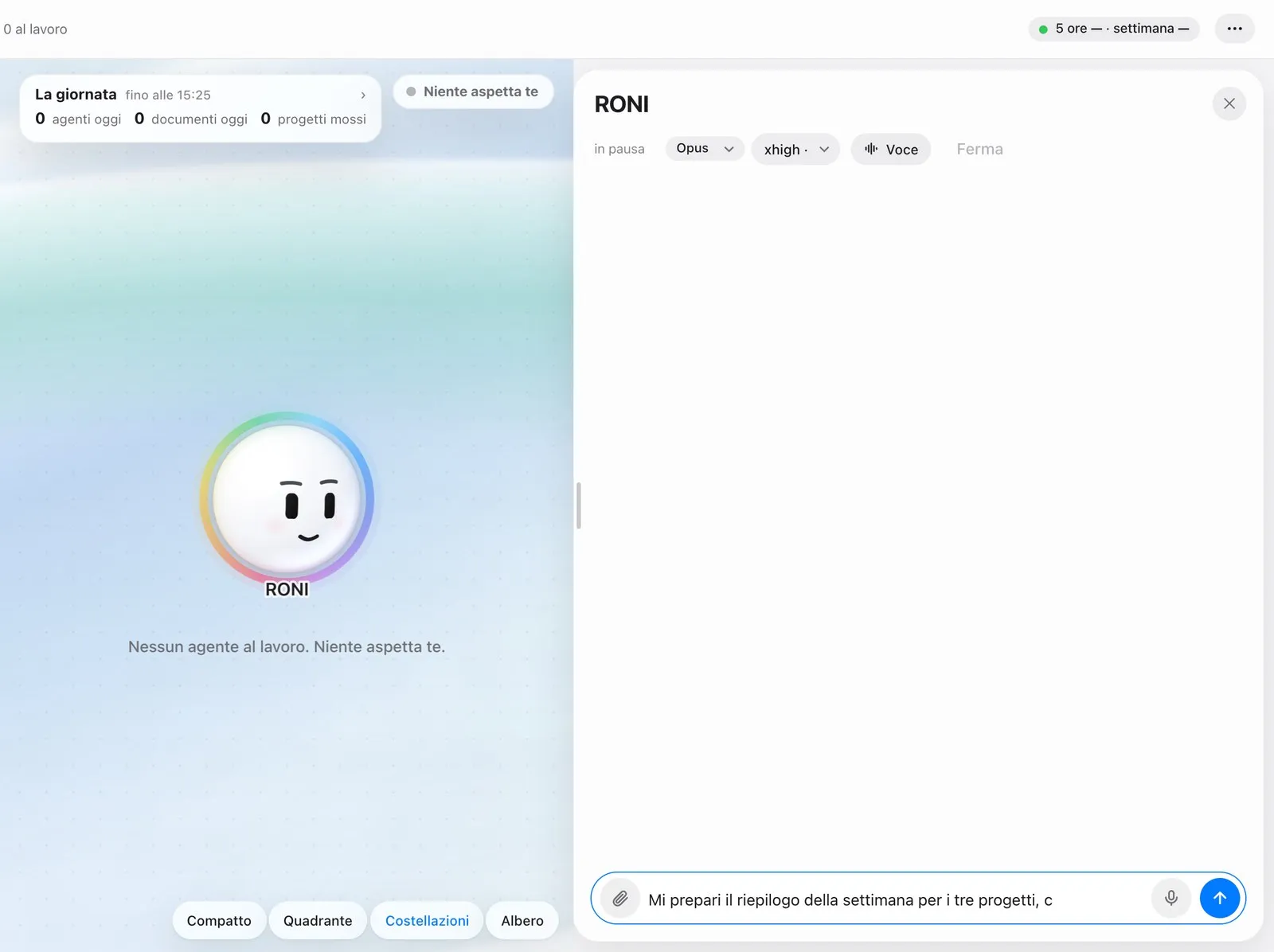
It reads me while I type, on a test copy of RONI’s desk.

It knocks because something new is waiting for my answer.

When it is yellow, it is my turn.

At night it sleeps.
The celebration is the strictest rule, and I wanted it that way on 28 October. It fires only with the rubric all ✓, and with the ✓ and ✗ lines mandatory in every agent’s delivery. An agent that has finished the work has not yet shown that it did it well, and with many agents a celebration at every finish would turn into noise. Sure, the agent fills in its own report card, but that is still better than a celebration at every delivery.
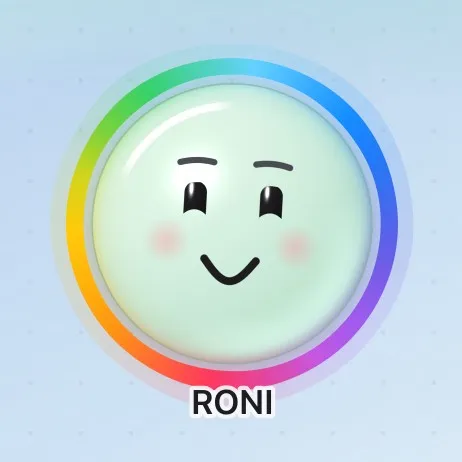
The celebration only comes when the delivery has every ✓.
Another route was to have the model declare its mood at the end of every answer. We discarded it because no fact on RONI’s desk would have confirmed it, and it would have been joy on command. A signal I can read out of the corner of my eye saves me a line of text, while one that lies teaches me to ignore it. That is why every face has a real fact behind it, and it is customer experience as much as the map is. The worried face was born with Giarbis. When something throws an error it stays on for eight seconds, and since 9 October it has been coral. Next, it should also fire when one of my routines turns red.
5. An assistant with five hats
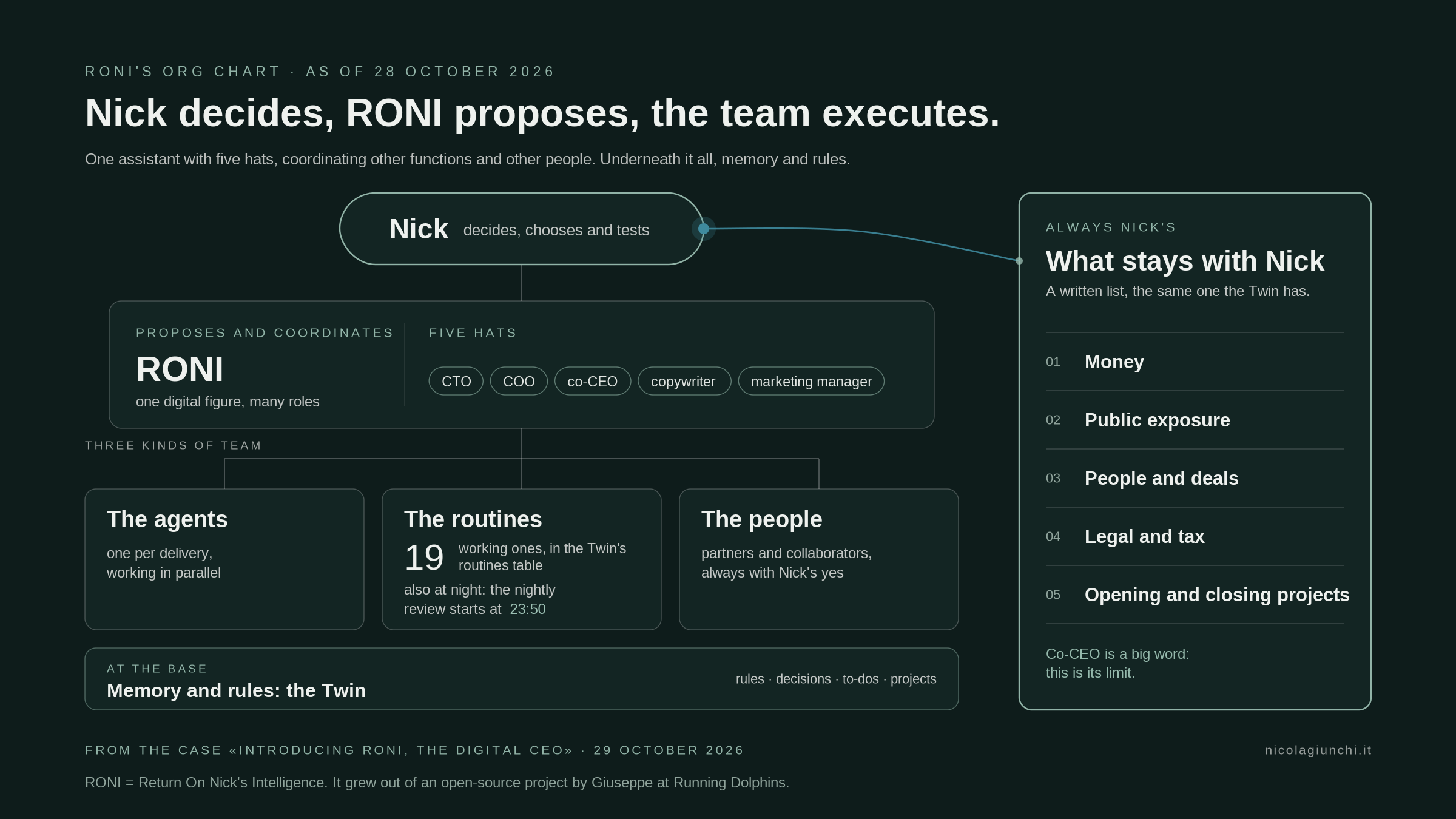
I describe it like this: my CTO, my COO, my co-CEO, my copywriter and my marketing manager. A set of roles joined in one digital figure, which in turn coordinates other functions and other people.
The hierarchy is simple. I decide, choose and test; RONI proposes and coordinates; under it works a team of three kinds. There are the agents, one per delivery, and on the peak day of the three weeks from 7 October, the 21st, 12 sessions worked in the same ten minutes. There are the routines, 19 active working ones as of 28 October, some at night too, since the nightly review starts at 23:50 and the first Monday routine at 5:30; and finally the people, partners and collaborators, who always go through a yes from me. Under it all sit the memory and the rules, that is the Twin, with decisions, pending items, incidents, to-dos and projects from 27 repos in 5 categories.
Co-CEO is a big word, and indeed some things stay mine alone. They are a written list, the same one I gave my Twin: money, public exposure, people and deals, legal and tax, opening and closing projects, while RONI learns from its own mistakes by tracking them (I tell that story in chapter 7).
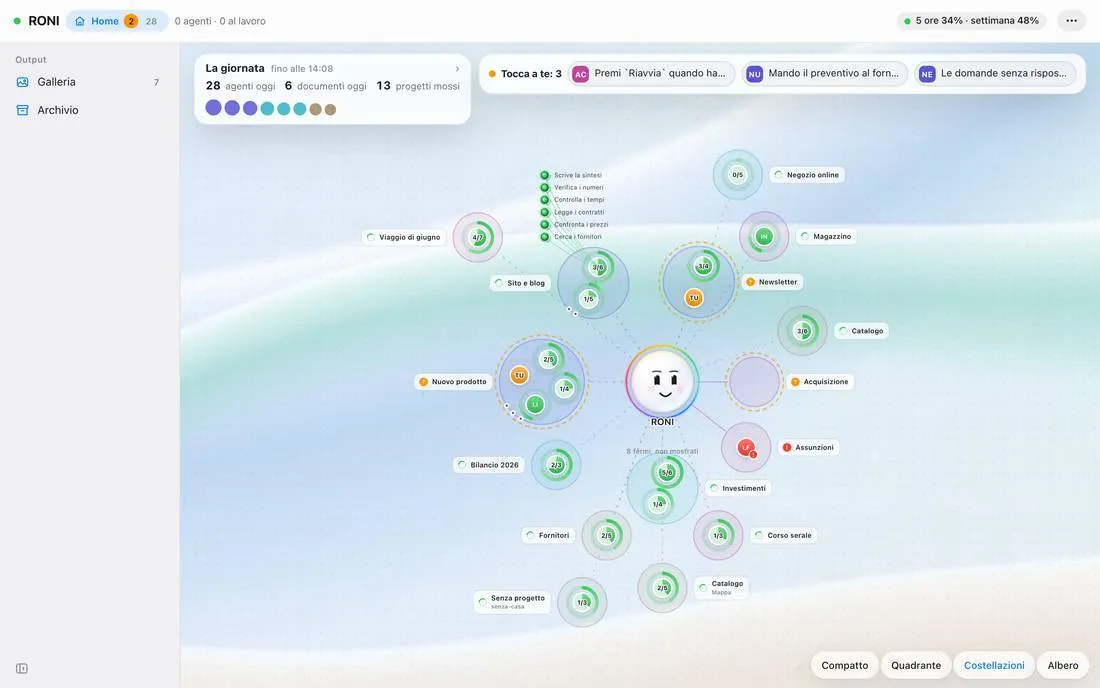
A swarm of six sub-agents, each with its own task.
6. Decisions, one at a time
From 13 to 27 October RONI put 827 things in front of me, in a queue. It does not take decisions away from me, it brings them one by one, with the recommendation alongside.
It was what I was after. On screen, only the things that matter, and the decisions put simply, to be taken one after the other. Every pending item, that is everything waiting for me (a decision to take or an action only I can carry out), arrives with the question and RONI’s recommendation. The recommended option is already highlighted, and a counter says “1 di 2” (one of two). I answer with a tap or with two written words. Actions that are mine have a single button, “Fatto” (done).
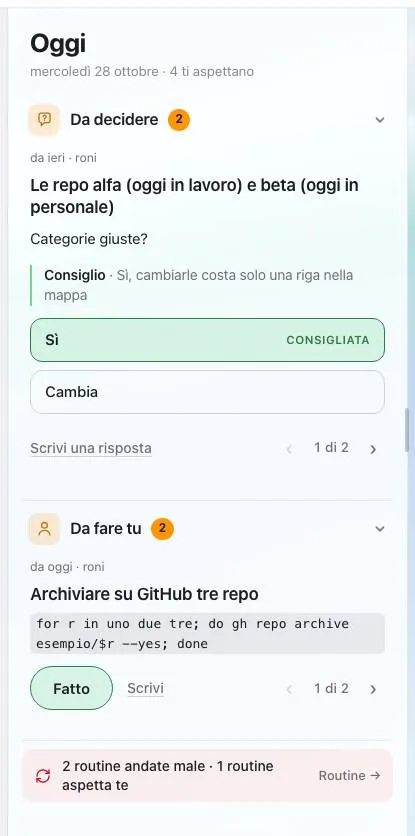
Decisions one at a time, with question, recommendation, recommended option and “1 di 2”.
The pending-items log starts on 13 October. In fifteen days 827 of them arrived: 609 decisions, of which 567 taken, and 218 actions. Of these, 725 got an answer, 90% of them on the same day, 92 were cancelled and 10 are still open. The busiest day was 16 October, with 142.
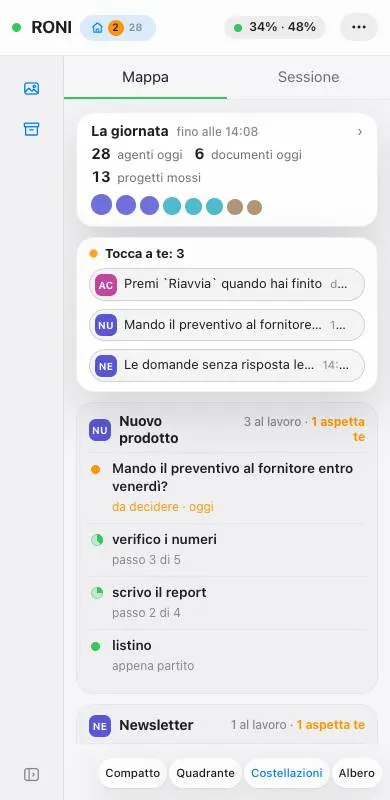
On the iPhone, the day and what is my turn, project by project.
7. The routines and the dream
The routines work while I am away, and at night the system reviews its mistakes. The incident log was born the day after RONI arrived. The agents write in it too.
My day with RONI starts at 8, with the good-morning briefing. It puts in front of me the projects that matter today, the calendar, the emails to answer, the open decisions and to-dos, the routines that went wrong and at most three goals to fit into the free slots in my diary. I find it on the desk and on the iPhone, where RONI also answers me on iMessage. I decide with two words, it sends me the files.
The working routines switched on, the recurring ones that produce something for me, were 14 as of 6 October. As of the 28th they are 19, in the Twin’s routines table. I count them without duplicates and without the service ones, such as the automatic code save. When one goes wrong, the routines page tells me what happened and what to do. Then I can retry at once or ignore it until the next run.
Each front has its own: the site report on Monday, the LinkedIn post numbers almost every morning, the investments in read-only mode, the management accounting of one of my companies at the start of the month, the weekly consulting report. Then there is the Twin’s circle, which I asked for myself in a single sentence, “Fammi 5 domande al giorno per chiudere il cerchio” (ask me 5 questions a day to close the circle). Since then it keeps five questions open at a time, on decisions to review and on hypotheses about me. Underneath it all, every 15 minutes, the files of all the projects save themselves.
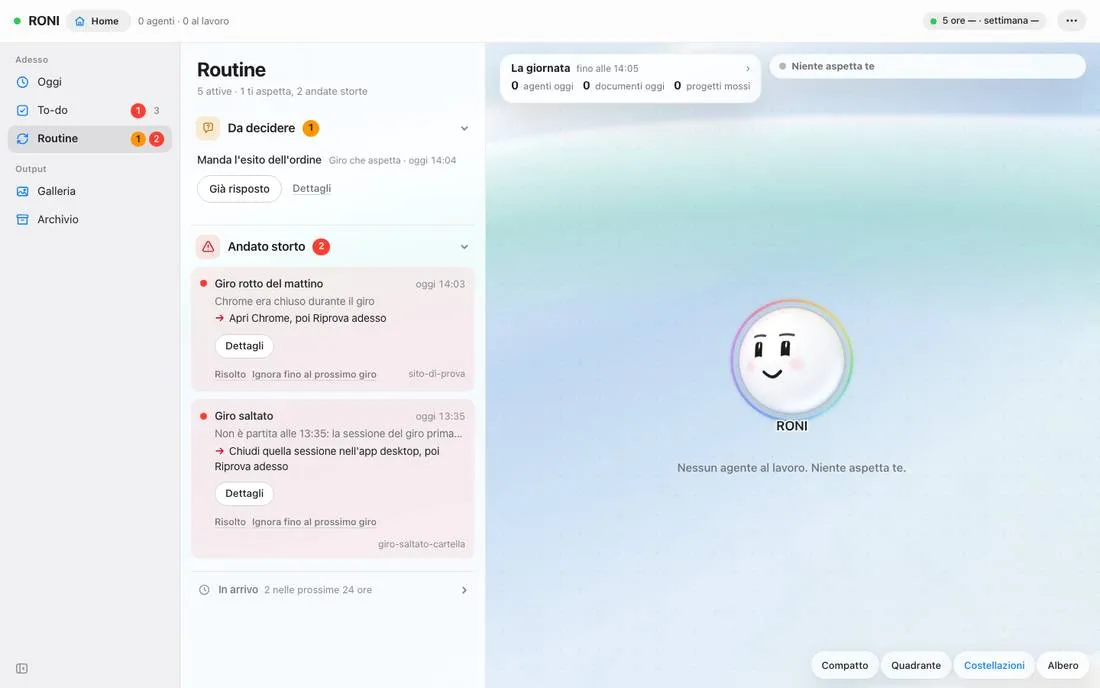
The Routine page says what waits for me, what went wrong and what to do.
The dream is the nightly review. From Monday to Saturday, at 23:50, a model with no tools rereads the day, the mistakes and the times I corrected RONI, and updates its lessons (30 at most, and each one lives 30 days). In the morning I find a diary and a question. If it wants to change something in the system it proposes it to me, one proposal at a time, and first runs it past an independent judge. From 16 to 27 October it wrote 26 lessons in 10 nights, and from 24 to 28 October it made 12 changes to its own measures and rules. The lessons stay private, here I only report the count.
On Sunday evening two more checks run. At 20:30 the health check goes over the whole system and only bothers me when an area turns red. At 21:30 the weekly review looks at how I used the Mac (metadata only) and Claude, and proposes at most three improvements, each with the evidence, the cost and what gets dropped. The following week it measures them, and if the dream counted wrong it corrects it.
The heartbeat, on the other hand, was already in Giuseppe’s project. At fixed times a script gathers the signals without bothering the model, and if it finds something new RONI leaves me at most one proposal (silence is fine too). For now I keep it off and switch it on when needed.
Then there is the incident log, where every error of the system ends up, be it an ignored rule, stale data or a routine that does not do its job. It was born on 8 October, the day after RONI arrived, and up to 27 October it collected 79 incidents, written by me and by the agents. Before, errors were not counted, and the entries with an older date were reconstructed after the fact. That is what I told RONI on 28 October: “we found more errors because now you measure them, before they weren’t measured”. What that 79 means I explain in chapter 9.
8. What came out of it
Three weeks, the management accounting of two companies optimised and the software of a measuring instrument reprogrammed.
The first is the SaaS company where I am CFO, the second my consulting firm, and in both I optimised the whole management accounting. Then there is the most unusual job, the software of a client’s measuring instrument, reprogrammed starting from the hardware.
What surrounds them, on the other hand, can be counted. In the three weeks after RONI arrived, the repos Claude and I worked on went from 14 to 20 (from 11 to 17 without the machine itself, that is the desk, the Twin, the configuration and the dashboard), and the lines written in text and code from 121,670 to 223,575. As of 28 October the Twin holds 14 main active projects, 45 with the sub-projects, split between business (6), the machine itself (4), investments (2), consulting (1) and one that has no repo.
All this work does not end up as walls of text. RONI delivers HTML pages that I open from the iPhone too, and I find them again in the Gallery, split by project and by day. With slides I had already made the jump before RONI, replacing them with HTML, now it applies to everything.
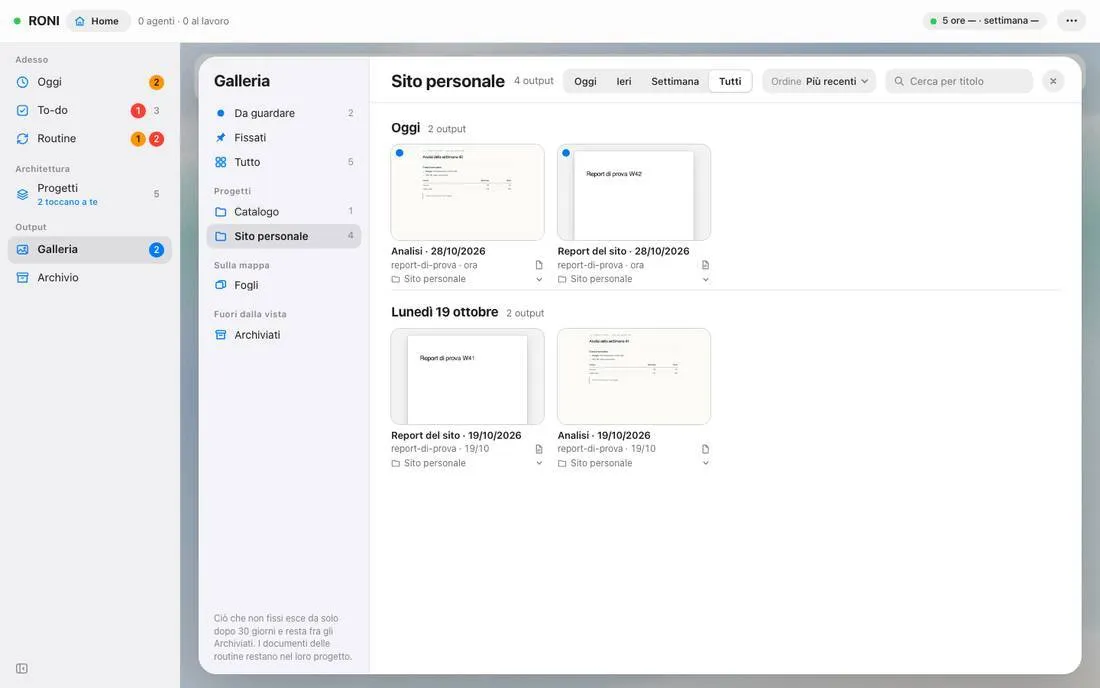
The Gallery, where I find every page again, project by project and day by day.
9. What the numbers say
Three weeks before RONI and three after, on the same Mac.
Before means from 16 September to 6 October, after from 7 to 27 October. They are 21 days each, Rome time, only this Mac (the laptop is not counted). The sessions are those of the desktop app, the terminal and RONI. Left out are the scheduled routines, the tests and the restarts of the same agent after a handover.
| Measure | Before | After | How to read it |
|---|---|---|---|
| Sessions in parallel, typical day | 3 | 7.5 | median of each day’s peak, sessions active in the same 10 minutes |
| Sessions in parallel, peak day | 6 | 12 | same definition, the maximum of the window |
| Hours a day in which I write or decide | 2.3 | at least 2.5 | 10-minute blocks with a message or an answer of mine; an independent count gives 2.4 |
| Span of the day | 9.0 hours | 11.6 hours | median between my first and my last message |
| Days with messages after 22:00 | 2 | 7 | |
| Sessions started | 57 | 244 | different units: with RONI a session is often an agent with a single task; after, 228 from RONI, 14 from the app and 2 from the terminal |
| Sessions with an independent check | 14% | 49% | 8 out of 57, then 120 out of 244; with a wider perimeter of sessions 10% and 39% |
| Incidents logged | not counted | 79 | log born on 8 October; the agents write in it too |
| Working routines switched on | 14 | 19 | no duplicates and no service routines |
| Repos with at least one commit | 14 | 20 | outside the machine: from 11 to 17 |
| Lines written in text and code | 121,670 | 223,575 | outside the machine: from 102,249 to 140,503 |
The pair that holds up the thesis is in the first rows. On the typical day the sessions in parallel more than double, from 3 to 7.5. The time in which I write or decide rises only a little, from 2.3 to 2.5 hours a day, with a jump that does not come gradually. Week by week, from the end of August to the week of 5 October, when RONI’s desk arrived, the average daily peak stayed between 2.6 and 3.7 sessions. Then it was 7.7 in the week of the 12th, 7.1 in the week of the 19th and 7.0 on the 26th and the 27th.
I am convinced that with RONI I manage to follow ten to twelve projects in parallel. The numbers say 12 sessions on the peak day and 7.5 on a normal day, and that is fine, a session is not quite a project. On the “before”, on the other hand, my memory did not betray me. With the desktop app I used to say four or five sessions, and the measured maximum is 6.
Then there are the numbers that, at first sight, seem to pull the other way.
The day gets longer
With RONI I work longer, and the numbers say so plainly. I used to stop at 17:36, now at 20:18 (these are medians), and the day has gone from 9 hours to 11.6. The evenings when I was still writing after 22:00 were 2 in three weeks, they became 7. It looks like the opposite of what I am telling you, and yet for me it is the proof. On 28 October I put it to RONI like this, “now I don’t have any problem anymore and I work more, precisely because I’m less tired”.
Errors, counted at last
Seventy-nine errors in twenty days. Put like that it sounds like a disaster, but that number needs to be read properly. The incident log was born on 8 October, the day after RONI arrived, and before that nobody counted errors (the few older entries we reconstructed afterwards). So there is no “before” to compare it with. That 79 says one thing only, that errors can now be seen, partly because the agents log them too.
Quality
On 28 October I put it like this, “quality has improved because the outputs are better, my decisions are clearer, the agents work better and better”. Two numbers point the same way. From 7 to 27 October 49% of sessions went through an independent check, against 14% in the three weeks before, thanks to RONI and to the rules I added on 14 and 24 October. In the dream, too, the times I correct RONI fell from 6.7 to 5.0 per 100 messages between the first and the last five nights measured. In December we will see how far they go.
Part of the growth is the tool itself
In the git of my repos, between the three weeks before and the three after, the lines written on the machine went from 16% to 37% of the total. By the machine I mean RONI’s desk, the Twin, the configuration and the dashboard. On their own they account for 62% of the increase (63,651 lines out of 101,905). Outside the machine the growth is 37%, not 84%. In May I wrote that spending the afternoon configuring a tool has the look of productivity and is only motion, and this row is here to keep me honest about my own tool too.
10. What an entrepreneur who does not write code can copy
You do not need RONI’s desk. You need to look at AI with the question you ask yourself in front of a customer. What is it like for the person using it, and where do they get tired?
You start from where you get tired, not from where the AI slows down. In my case it was not the speed of the model, it was remembering where I had got to on four or five fronts. If your head hurts in the evening, the question to ask is about what you have to keep in mind, even before the model you use.
The second move needs no software. In your assistant’s standing instructions, the ones that apply to every conversation, you can write a single rule. Every answer ends with the decision that is yours to take and with the AI’s recommendation. It is half of the decisions panel, and it costs nothing.
The third is reading pages instead of walls of text. Asking the AI for an HTML page instead of a paragraph and opening it in the browser changes the way you read a summary, from the phone too.
The fourth is a written status for each project, so that going back to it does not mean rebuilding it from memory. It was one of the directions I had set myself in June, and it works with a simple shared document too.
Anyone who wants to try a real interface, on the other hand, has Giarbis, Giuseppe’s open source project. The README explains the installation step by step, with what you see on screen after every command, and asks for a Claude Pro or Max subscription. It takes a little patience with the Terminal the first time, then you work in the browser.
In closing
The power was already there. What was missing was a way to keep up with it.
In June I had written that I needed an orchestration layer able to bring me only the decisions, and I did not know where it would take me. Four months later I have that layer. I have created my own “Digital Alter Ego”, but far more capable and hands-on than me.
Of course it is not perfect. The training is not finished, and neither are the features I can add or the improvements I can make, but that is exactly the beauty of it, isn’t it? The process that will get me to 100% satisfaction will at the same time increase my ability to use AI, give me new intellectual skills and push me to compete with AI to keep getting better, and I will finally be able to do all this on my own. Without depending on a piece of software, without depending on one or more developers, without depending on a company rule, without having to make compromises that end up squeezing quality or, worse still, end up limiting my expectations.
For years, in companies, I looked for the added value nobody had seen yet. With AI it was in a place I had never looked, in the experience of the person using it. That is, mine.
Technology runs faster than we do, and it will keep doing so. Next month’s model will be more powerful than today’s, but if on the other side there is a person cooked by four in the afternoon, what good is all that power to us?
So I will leave you with the questions I asked myself. Where do you get tired when you work with AI? How many things do you keep in mind that a machine could keep for you? How many decisions do you really take, and how many do you chase? If your AI were a company and you were its customer… would you go back?
To demand better you do not need to know how to write a line of code, you need to stop adapting to the tool and start asking it to adapt to us. I started from my frustration. Where will you start?
For the other cases of how I work with AI, the index is here. If you want to talk about it, write to me.