
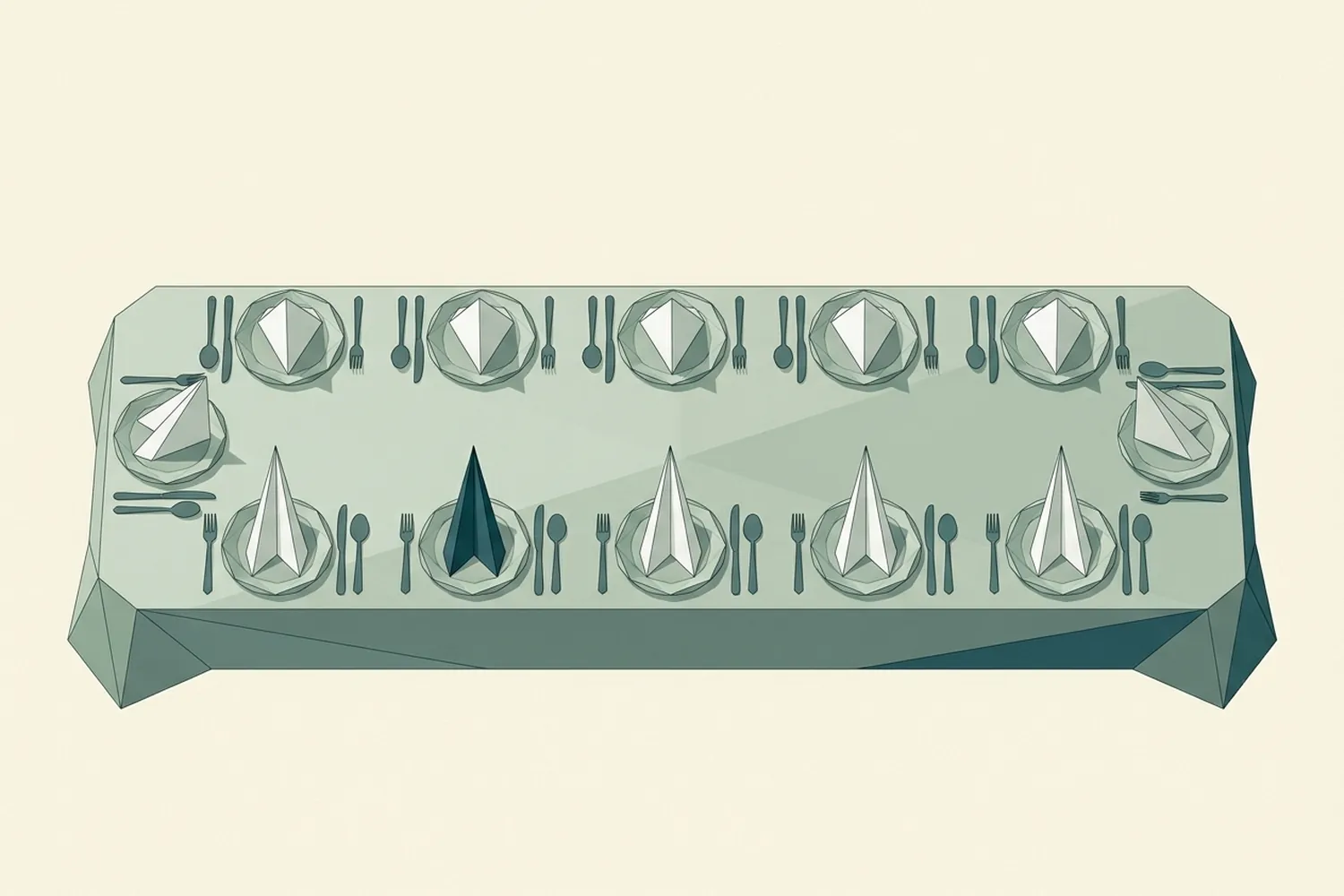
Picture a full dining room. There is a white napkin on every plate except one: the customer walking in for the first time finds a red napkin. They have no idea what it means, but the room does. Whoever brings the bread, whoever pours the water and whoever stops by to ask if everything is fine recognises them and treats them like a star, and at the end of the meal there is a small gift, so they have a reason to come back.
I heard the story in July from an American restaurateur, and then found out it is a method of Jon Taffer, the consultant from the TV show Bar Rescue. Taffer spreads it over three visits: a free dinner the first night, a handwritten discount for the second, cheesecake on the third. He says it costs about six dollars of ingredients in all: that’s his own sum, not a study’s.
The story captures the thing I have been looking for in every company for twenty years: the added value nobody has spotted yet. It’s the special thing, the unique and slightly unexpected detail the customer takes home. When a product has it, customers stay, margins go up and churn stops being a problem.
What does the customer actually buy?
That value often lives in an oxymoron. Take coffee: caffeine is a stimulant, yet nobody at the bar asks for a stimulant, we ask for a break. What we pay for is the five minutes in which we stop, far more than the caffeine.
Social networks went the other way. They were sold to us as the way to be together, and they often leave us lonelier. In 2018 the University of Pennsylvania measured it on 143 students: those who for three weeks limited Facebook, Instagram and Snapchat to ten minutes a day each saw loneliness and depression fall more than those who used them as usual.
In both cases the customer buys what they feel, before what the thing does. That’s where the value hides. It holds in B2B too: a purchasing department is made of people who remember who treated them well.
Who already has a red napkin?
I found quite a few, and they almost always cost very little: the real work is making sure the whole company sees them.
At Disney World, first-time visitors can pick up a free button that says «1st Visit!», with space for their name. From then on, park staff who see it usually say hello and congratulate them.
At Costco the hot dog and soda combo has cost a dollar fifty since 1985. Craig Jelinek, the former chief executive, tells how he went to co-founder Jim Sinegal to say they couldn’t sell it at that price any more. The answer was: «If you raise the effing hot dog, I will kill you. Figure it out.» The fix was building their own hot dog plant, and the price stayed where it was.
Then there’s the counter-example: what happens when the red napkin is taken away. For more than fifty years bags flew free on Southwest Airlines, and the airline had turned it into a slogan: «Bags fly free». Since 28 May 2025 the first checked bag costs 35 dollars, and when it was announced the American press called it the end of an era.
How do you design a red napkin?
A red napkin has three parts: a visible signal that sets the whole company in motion on the right customer, an immediate benefit for that customer, and a detail that stays in their mind. If one is missing, it’s a gadget. A napkin nobody recognises is just coloured cloth, and a gift without the rest is a discount.
The hard part is the first one, because the signal is for the people in the company more than for the customer. Often the customer doesn’t even know it exists: they only know they are being treated better.
Here are the other examples, broken down that way.
| Who | The signal | Who springs into action | The detail that stays |
|---|---|---|---|
| Jon Taffer’s method | A red napkin on the first-timer’s table | The whole staff, then the manager with a handwritten card | A free dinner the first time, a handwritten discount for the second, cheesecake on the third |
| Disney World | A free «1st Visit!» button, with the name handwritten | Park staff who see it | The greeting and congratulations, sometimes a treat |
| Pret A Manger | The barista picks the customers they like (chief executive Clive Schlee’s example, in 2015: «the person on the bicycle») | The staff, with a weekly budget instead of a loyalty card | Something free for no reason: in 2015, 28% of customers got it |
| Ritz-Carlton | A guest with a problem | Any employee, up to 2,000 dollars per guest, per problem, without asking (Horst Schulze, 1980s) | The problem solved before it becomes a complaint, and the 2,000 dollars almost never spent |
| DoubleTree by Hilton | Arrival at the hotel | The front desk | The warm cookie, at the front desk since 1995 (since 1986 as a turn-down treat): 483 million as of February 2020 |
| Zappos | A VIP customer | Logistics, upgrading shipping to overnight without saying so | The parcel that arrives sooner than expected. In 2010, 75% of daily sales came from repeat customers |
| Chewy | A customer returning food because their pet has died | Customer service, as company practice | The refund, the suggestion to donate the food to a shelter, flowers at home |
| Costco | The 1.50-dollar hot dog since 1985 | The leadership, which defends the price | A lunch that costs next to nothing |
| Stripe, early days | A prospective customer who says «I’ll try it» | The founders: «give me your laptop», and they set it up on the spot | The integration done before leaving the room |
| Wufoo | Every new sign-up | The company, by hand, for as long as it could | A thank-you note written in pen |
| Southwest, until May 2025 | The bag to check in | Check-in, which asked for nothing | «Bags fly free», and the day it ended |
What happened when I checked my own projects?
On 8 July, the day I heard the story, I turned it into a rule. Every new project card has had a mandatory field ever since, with a single question: what is our red napkin? If it’s missing, the card isn’t finished.
Two months later I searched every card for that line. There are about twenty, and the field is filled in on four. On the others the answer is «candidate», which is the polite way of saying «I need to think about it», or there’s nothing at all. I wrote the rule myself, and the first person not following it was me. It isn’t the first time I have been the brake: I noticed it when AI started working faster than I could.
There had been a warning bell too, and I ignored it. Six weeks after the rule I was rereading the analysis of an industrial plan I’m working on, done with AI, and it said that customer acquisition cost was «the least validated assumption in the plan». I asked myself what that plan’s red napkin was, and I couldn’t answer on the spot. A mandatory rule nobody checks isn’t a rule, it’s a good intention with a sterner name.
Does the red napkin work outside the company too?
Yes. The idea is to give someone value before you ask them for anything, and it works the same way with the people you work with and the people you love: a signal that says «I saw you», a benefit that arrives before the request, a detail that stays.
In Naples they have done it with strangers for generations, with the caffè sospeso: you pay for two coffees and drink one, and the other will be drunk by someone you will never meet. It’s what I have always tried to do, or at least hoped to do, with my colleagues too.
How do you reduce customer acquisition cost without advertising?
Advertising brings customers right away, but it buys demand, and if you’re already full the extra demand turns into waiting, which means unhappy customers. The red napkin works the other way round: it doesn’t bring more people in, it brings the right ones back and gets them talking about you.
Do one thing, on Monday. Open the budget, or the plan, and look for the customer-experience line. Not the marketing line or the discounts line: the one that says what the right customer sees when they arrive, and who in the company springs into action on seeing them. If all you find is a discount, you don’t have a red napkin. If you have to think about it, you don’t either. In most of my projects, I’m still at «I need to think about it».
That line is usually missing because it doesn’t show up in the numbers right away, and we skip it the way we skip the boring exercises at the gym: I wrote about it in strengths and blind spots.
The rule was right on 8 July and it still is. I had just filed it under mandatory things, when it belonged under measured things. Taffer doesn’t write principles: he has a red napkin put on the table. Disney printed buttons, Costco defended a hot dog for forty years. Nobody did anything complicated. They decided who had to feel seen, and then made sure the whole room saw them. I still have a whole dining room to set, and for once I know which table to start from.
If that line is in your budget, with a number next to it, write to me: I’d like to see how you measured it.
Sources: Jon Taffer on the red napkin and his numbers (Gary Vaynerchuk, «The Three Best Restaurant Tips for Customer Retention», 17 July 2017); Disney, free celebration buttons (TouringPlans, planDisney); Pret A Manger, Clive Schlee to the Evening Standard, reported by TIME on 21 April 2015; Ritz-Carlton, the 2,000-dollar rule (Travel Truth, 29 November 2025); DoubleTree by Hilton, Cookie Fact Sheet (figures as of February 2020); Zappos, Stanford GSB Insights, 1 October 2010; Chewy, Boston Globe, 16 June 2022; Costco, Snopes on Craig Jelinek’s account of 12 April 2018; Stripe and Wufoo, Paul Graham, «Do Things that Don’t Scale», July 2013; Southwest, CNBC, 26 May 2025, MediaPost, 12 March 2025, and Bloomberg, 11 March 2025; Hunt, Marx, Lipson and Young, «No More FOMO», Journal of Social and Clinical Psychology, 2018; my own project cards and the register of my operating rules, internal non-public documents.