

At the end of June I wrote that I had become the bottleneck of my own AI. Five projects open at the same time, and by four in the afternoon my brain was cooked. Four months later the title has a question mark, and the answer I found is not a more powerful model.
LLMs and AI agents are infinitely powerful, an incredible technology, which however needs to be supported just as well by a UI and a UX. It needs a customer experience of the same level, one that lets human beings, too, express themselves at their best alongside this technology. In my case the customer to be served was me.
Why does the terminal tire you more than the projects do?
Until August I used Claude Code from the terminal. I could handle two projects in parallel, three at most, and after six or seven hours my brain was fried, because black screens, full of nothing but text, are exhausting.
In August I moved to the desktop app. On a very large screen I kept four or five sessions open, but at some point I no longer knew where I had got to with each of them, and in the evening I had a headache.
The engine was always the same, and it worked beautifully. The weak point was in the way I talked to it. Interacting naturally with an AI that works on its own on a task, and keeping control of all the open projects, asked more of my head than it could give. A company with an excellent product and an experience like that would lose its customers.
What does an interface built for deciding change?
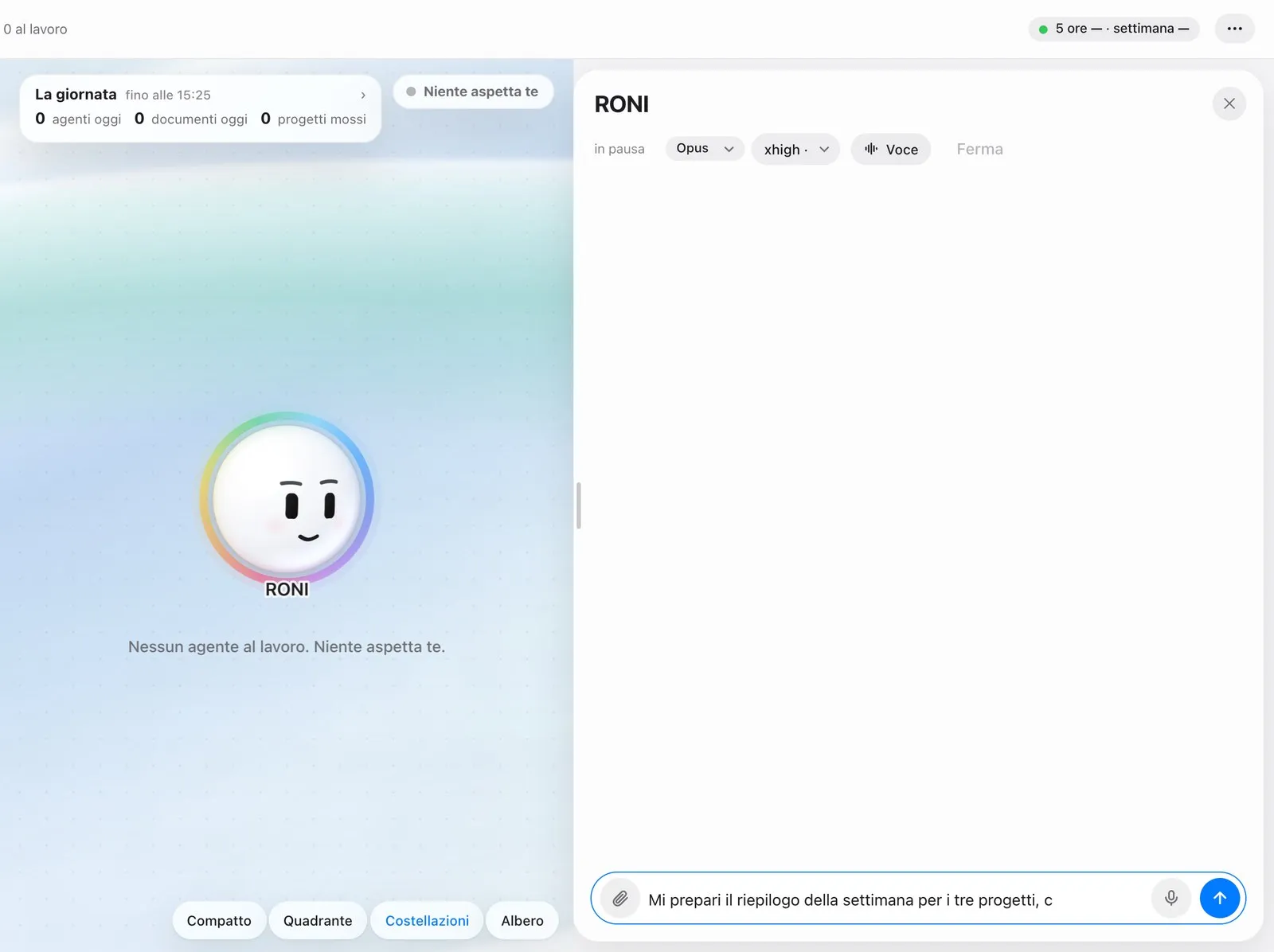
Since 7 October I have been working at RONI’s desk. I did not invent it. It comes from Giarbis, which Giuseppe of Running Dolphins (where I am an Advisor) released as open source. It reached me already working, with the map, the face, the swarms of sub-agents and the to-do list. From there we built on top of it for three weeks, with the agents writing the code while I chose and tested.
Explained without code, it is four layers. At the top there is a map in the browser, on the phone too, with one island per project and the agents circling around it. Below that, a small server that runs only on my Mac and that I can also reach from iMessage. Then the Claude Code sessions, which work in parallel on my subscription, and at the bottom the folders of all the projects, with the system where I keep rules, decisions and to-dos.
The heart of RONI’s desk, though, is the decisions. RONI brings them to me one at a time, each with the question, its recommendation and the recommended option already highlighted, and I answer with a tap. In the pending-items log, from 13 to 27 October, it put 609 of them in front of me, and I took 567. In September, writing about meetings, I proposed a rule for the decisions that carry weight: the AI prepares and people decide. With RONI the same rule applies to my everyday work.
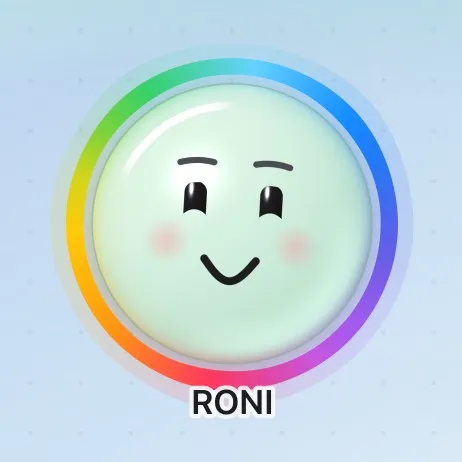
RONI’s face follows a rule too, one that was already in Giuseppe’s project and that I tightened on 9 October: every face has a real fact behind it, and none of them fakes a feeling. With the expressions that arrived on 28 October it reads me while I type, turns yellow when it is waiting for me, knocks at every new pending item (at most eight times an hour) and sleeps at night. It celebrates only when an agent delivers a piece of work with a ✓ on every criterion of its rubric, because finishing is not enough. The rainbow ring, which is there at rest too, spins fast for a couple of seconds and the drop turns green. It looks like a whim, but a signal I can read out of the corner of my eye saves me from reading, and one that lied would teach me to ignore it.


How many projects can you really hold in parallel?
I compared three weeks before RONI (16 September-6 October) with the three after (7-27 October), on the session logs of a single Mac, leaving out scheduled routines, tests and restarts after a handover. On the typical day, that is the median, the sessions at work in the same ten minutes went from 3 to 7.5, and on the peak day from 6 to 12. The time in which I write or decide, on the other hand, barely rose, from 2.3 to 2.5 hours a day.
That is the pair that counts. The AI works on many more fronts at the same moment, while the part that falls to me stays almost the same. My explanation, given on 28 October, is a simple one: “I work more, precisely because I’m less tired”.
I am convinced that I follow ten to twelve projects in parallel. The numbers say that twelve is the number of sessions on the peak day, and a session is not quite a project. The real projects, as of 28 October, are the 14 main active ones in my system, and they become 45 if I count the sub-projects too.
Am I working better or just more?
I certainly work more.
The day has got longer. In the same three weeks before and three after, the span between my first and my last message of the day went from 9.0 to 11.6 hours (median). The last message used to arrive at 17:36, now at 20:18, and the evenings when I am still writing after 22:00 went from 2 to 7.
Then there are the errors. The incident log was born on 8 October, the day after RONI arrived, and up to the 27th it collected 79 of them, written by the agents too. Before, nobody counted them. Now they can be seen, and that is the first step to not repeating them.
On quality I have a conviction, and two numbers that point the same way. From 7 to 27 October 49% of sessions went through an independent check, against 14% in the three weeks before, with RONI and with the new rules that arrived in those weeks. In the metrics of the nightly review, the times I correct the assistant per 100 messages fell from 6.7 to 5.0 between the first and the last five nights measured, from 16 to 27 October.
Then part of the growth is the tool itself. Of the extra lines of text and code in the three weeks after, counted in the commits of all my repos, 62% went into RONI’s desk and the system around it. In May I wrote that configuring a tool instead of doing the real work has the look of productivity and is only motion. That sentence applies to RONI’s desk too, which is why I write the number down.
What can an entrepreneur who does not write code do tomorrow?
To begin with you do not need RONI’s desk. You need to look at your own way of working with AI the way you would look at a customer’s experience, asking yourself where you get tired and why.
The first move costs nothing. Ask your assistant, in the instructions that apply to every conversation, to always end with the choice that is yours and with its recommendation. The second is to ask for an HTML page instead of a wall of text, and to open it in the browser, from the phone too. The third is to keep a page for each project with the point you have reached, so you do not have to rebuild it from memory every time you go back to it.
Anyone who wants to go one step further can start from Giuseppe’s project on GitHub. The README explains how to install it one command at a time, showing what appears on screen after each one, and it works with a Claude Pro or Max subscription.
In the piece on the red napkin I wrote that for twenty years I have been looking, in every company, for the added value nobody has seen yet. With AI, for me, it lay in the experience of the person using it. How RONI’s desk is built, with all the numbers, I put in the full case, and the other ways I work with AI are on this page.
You, in the evening, how much does keeping up with your AI wear you out?
Sources: Claude Code transcripts on a single Mac, RONI’s log, the git of my repos and the tables of my working system (pending items, incidents, routines, projects), extracted on 28 October 2026 with read-only scripts and recounted by four independent checks; windows 16 September-6 October and 7-27 October 2026. Giarbis, public repository by Giuseppe (Running Dolphins), MIT licence: https://github.com/giuseppedolphin/giarbis